

Georgia governor candidate profile: Keisha Lance Bottoms
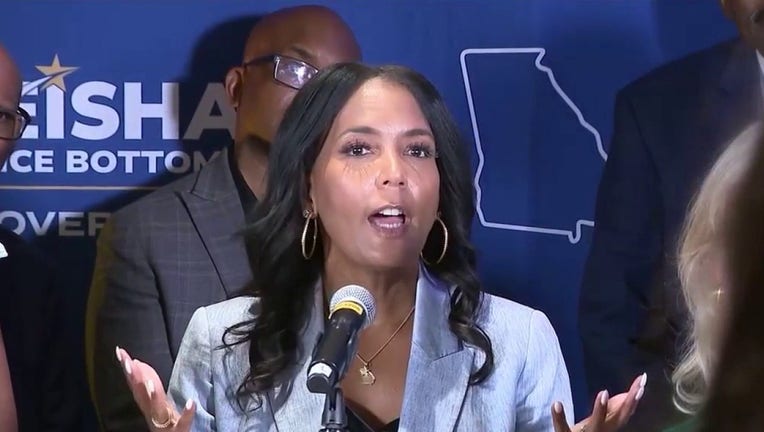
ATLANTA - Keisha Lance Bottoms is seeking to move from Atlanta City Hall to Georgia’s highest office, campaigning on affordability, health care and education while defending her leadership during the coronavirus pandemic and a period of rising violent crime.
Georgia’s 2026 midterm election: The major races and candidates
Bottoms won the Democratic nomination in May and faces Republican health care executive Rick Jackson in the Nov. 3 election. They are competing to succeed Republican Gov. Brian Kemp, who cannot seek a third consecutive term.
Personal background and education
Bottoms grew up in Atlanta and graduated from Frederick Douglass High School. She earned her undergraduate degree from Florida A&M University and a law degree from Georgia State University.
She is the daughter of Sylvia Robinson and the late R&B singer Major Lance. Bottoms has spoken publicly about her father’s imprisonment on a drug charge and her mother’s struggles to support the family, describing those experiences as influences on her decision to study law and enter public service.
Bottoms is married to Derek W. Bottoms, an attorney. They have four children.
Sources: City of Atlanta biography; The Atlanta Journal-Constitution’s biographical profile.
Legal career, City Council and mayor’s office
An attorney and former magistrate judge, Bottoms was elected to Atlanta City Council in 2009 and reelected in 2013. She represented District 11 in southwest Atlanta.
She also served as executive director of the Atlanta Fulton County Recreation Authority, where she helped broker the sale of Turner Field and surrounding parking lots to Georgia State University and a private development group.
Bottoms defeated Mary Norwood in the 2017 mayoral runoff and served as Atlanta’s 60th mayor from 2018 to 2022. She announced in 2021 that she would not seek a second term. ajc.com
Sources: AJC biography and career history; FOX 5 Atlanta’s overview of her mayoral tenure; FOX 5’s coverage of her final news conference.
White House experience
After leaving the mayor’s office, Bottoms served in former President Joe Biden’s administration as director of the White House Office of Public Engagement. An early Biden supporter, she was also considered as a potential running mate during his 2020 presidential campaign.
Source: Associated Press coverage of her gubernatorial campaign launch.
Campaign platform: Health care
Bottoms supports full Medicaid expansion and has described it as a priority for the beginning of her administration.
She has criticized Georgia Pathways, the state’s more limited Medicaid program, arguing that it has not provided coverage to enough residents.
During the October gubernatorial debate, she also proposed stronger action against health insurers that repeatedly deny coverage and said patients should be notified when artificial intelligence is used to review claims.
Sources: FOX 5 coverage of her health care agenda; FOX 5’s October debate coverage.
Campaign platform: Gas prices and auto insurance
Bottoms’ driving affordability proposal would eliminate Georgia’s 2.25% state tax on auto insurance premiums and require insurers to pass those savings to customers.
She also proposes limiting insurance rate increases to once a year, creating an insurance consumer advocate and establishing a low-cost basic policy for drivers who meet income requirements.
Her fuel proposal would lower the state gasoline tax to 28 cents per gallon. These are campaign proposals, rather than changes already enacted.
Source: FOX 5 coverage of gas and auto insurance plan
Campaign platform: Housing, wages and jobs
Bottoms supports establishing a statewide affordable housing trust fund to help address housing costs.
She has also advocated raising Georgia’s minimum wage to $15 an hour and making community and technical colleges tuition-free. Her campaign connects those proposals to helping residents afford basic expenses and gain access to better-paying work.
Sources: FOX 5’s October debate coverage; GPB’s Democratic primary debate coverage.
Campaign platform: Schools and early education
Bottoms wants to revisit Georgia’s decades-old school funding formula and fully fund education.
At a September early education forum, she supported allowing voters to decide whether Georgia should permit casino gambling. She said the resulting revenue could help fund pre-K programs. She also emphasized training early learning providers and providing safe learning environments.
Source: GPB’s coverage of the early education candidate forum.
Campaign platform: Abortion and maternal health
Bottoms supports repealing Georgia’s abortion restrictions and restoring protections consistent with the standard that existed under Roe v. Wade.
She also proposes expanding prenatal and postpartum care in communities with limited access to maternal health services and strengthening the workforce of obstetricians, midwives, doulas and community health workers.
Source: AJC reporting on the candidates’ abortion positions.
Campaign platform: Voting access
Bottoms’ proposed state voting rights legislation would make Election Day a state holiday, expand voting hours and allow verified student campus identification for voter registration.
She has also called for eliminating the State Election Board and increasing protections for poll workers.
Source: FOX 5’s reporting on the October gubernatorial debate.
Campaign platform: Data centers and surveillance
Bottoms supports pausing new data center construction while Georgia develops policies governing the industry’s expansion.
On police surveillance technology, she has said she is open to a moratorium on installing new Flock cameras while officials review privacy concerns and safeguards against misuse. wabe.org
Source: FOX 5’s reporting on the October gubernatorial debate.
Campaign platform: Immigration and federal policy
Bottoms has said cooperation between immigration authorities and local law enforcement should be responsible and lawful. During the Democratic primary debate, she pointed to her decision as mayor to stop allowing Immigration and Customs Enforcement to use Atlanta’s jail.
She has also said she would challenge President Donald Trump when she believes his policies harm Georgia, including opposing his tariffs.
Source: FOX 5’s reporting on the October gubernatorial debate.
Public safety record and criticism
Public safety has become a central issue in the governor’s race. Bottoms points to police pay increases and her support for Atlanta’s public safety training center as evidence of her commitment to law enforcement.
An AJC analysis found that Atlanta’s reported homicides rose 59% from 2019 to 2020, compared with a 33% increase in the other cities examined. The newspaper also reported that robberies and reported rapes declined in Atlanta during that period.
Criminal justice experts interviewed by the AJC cautioned against attributing pandemic-era crime changes solely to a mayor. Bottoms has disputed Jackson’s portrayal of her leadership, arguing that it overlooks the pandemic and other upheaval affecting cities nationwide. ajc.com
Sources: AP reporting on her public safety position; AJC analysis of Atlanta crime during her tenure.
Campaign finance violations
In 2021, Bottoms’ mayoral campaign agreed to pay a $37,000 state ethics fine for campaign finance violations connected to the 2017 election.
The agreement included admissions involving contributions above legal limits and other improper contributions. The AJC reported that many violations involved paperwork, while another involved retaining money raised to retire campaign debt beyond the amount owed. The ethics commission’s executive director described some improper contributions as procedural. ajc.com
Source: AJC coverage of the campaign finance settlement.
Historical significance
If elected, Bottoms would become the first Black woman elected governor in the United States. Her bid also seeks to make her the first Atlanta mayor elected Georgia governor.
Sources: The Washington Post’s campaign profile; AP reporting on the path from Atlanta mayor to governor.