

Are giant Joro Spiders ruining Georgia's ecosystem? A new UGA study
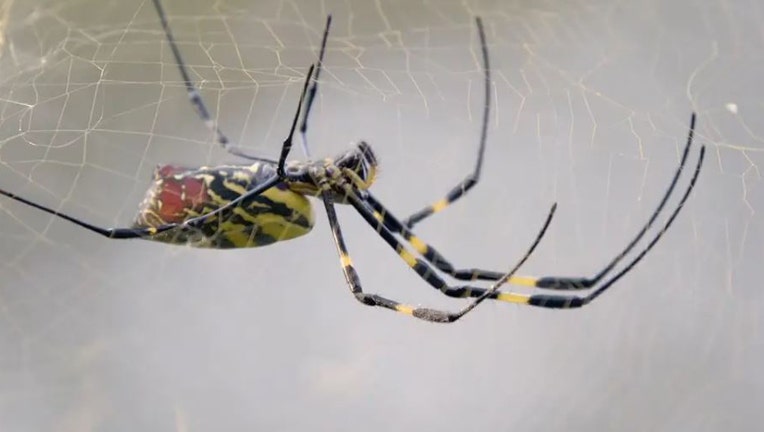
The large and brightly colored Joro spider is easily noticeable. Native to Southeast Asia and Japan, the eight-legged spawn of the golden orb-weavers was first found about 2013 in Georgia and has since spread across the state and into the Southeast.
ATHENS, Ga. - Invasive Joro spiders are not robbing native orb weavers of their daily meals, according to new research from the University of Georgia that analyzed the diets of hundreds of arachnids across Georgia and South Carolina.
Joro Spiders in Georgia
What we know:
Researchers analyzed stomach contents and DNA fragments from more than 200 Joro spiders and 140 native orb weavers collected across 33 sites in Georgia and South Carolina.
The findings show that while Joros share some prey with native species, their overall diets differ significantly.
Joros consumed 26 unique species that native orb weavers left untouched, focusing heavily on small pests like aphids, leafhoppers and flies. Native spiders maintained the exact same diet regardless of whether Joros lived in the immediate area.
Harmless Joro Spider impact
The backstory:
When the massive black and yellow spiders first arrived in the U.S. over a decade ago, scientists worried the invaders would gorge on local insect populations or outcompete native arachnids.
Concerns also emerged that their large, gold-hued webs would trap imperiled monarch butterflies. However, analysis shows Joros eat very few butterflies of any kind, functioning instead as natural pest control.
Managing invasive Joro Spiders
What they're saying:
"In terms of direct competition for food, our study suggests Joro spiders eat different insects and a wider variety as compared to native orb weavers," said Jason Schmidt, co-author of the study and a professor of entomology in UGA’s College of Agricultural and Environmental Sciences.
Schmidt noted that despite their intimidating size, Joros have timid personalities and are more likely to flee than bite. He strongly advises against spraying yards with broad chemical pesticides to eliminate them.
"In trying to kill the spiders, other beneficial insects feeding on pests in our yards will be impacted, and you’ll increase the likelihood of having a bunch of really difficult pests show up because you killed off some of the good guys out there," Schmidt said.
Joro Spider spread in Georgia
What's next:
Researchers agree that Joros are here for the long haul due to their cold-hardy nature and ability to adapt to busy roads, powerlines and gas pumps. Hatchlings will continue to spread each spring by ballooning across the wind on silk threads.
For residents who prefer not to host the creepy-crawlies, experts recommend physically removing individual spiders and webs rather than applying yard-wide chemicals.
The Source: The information in this story was gathered from a press release and study published by the University of Georgia, featuring insights from study co-author and UGA entomology professor Jason Schmidt, as well as research contributions from Valdosta State University.