

Expert shares tips on how to de-escalate dangerous conflicts

Expert in de-escalation teaches how to make it out of a tense situation alive
Security consultant Joshua Byrd offers FOX 5 Atlanta's Beth Galvin several tips for avoiding violent conflict.
ATLANTA - John Laster says the rage seemed to come out of nowhere.
The 33-year-old Atlanta music manager was driving to pick up lunch at his favorite Decatur restaurant August 18, 2020, when he got distracted at a stoplight.
The light turned green, and Laster hesitated a little too long, angering the driver of pickup truck behind him.
"There was no strong language used. There was no fingers pointed at each other," Laster says.
But at the next light, the man shot him.
"I see the window coming down, and I see a gun," Laster says. "As soon as I see the gun, I went like this. Instantly, after I went like this, I was shot."
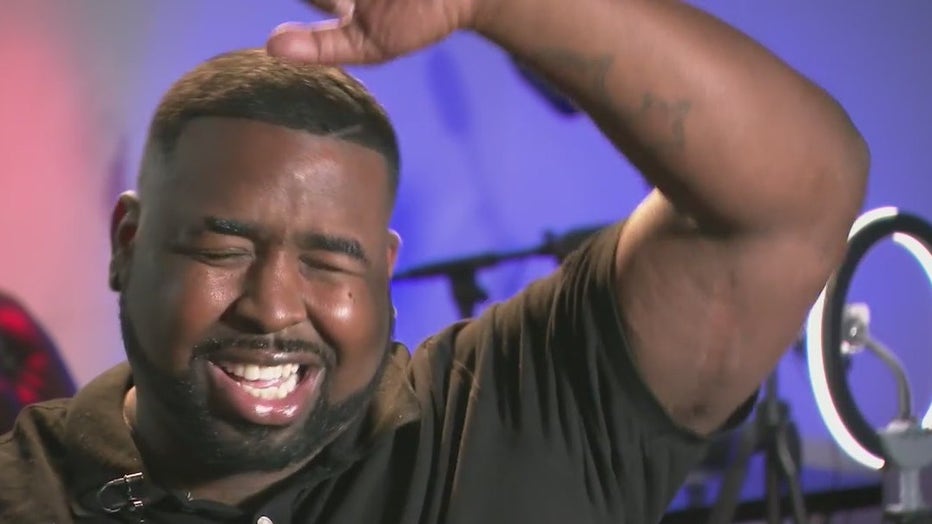
Laster demonstrates how he raised his arm out of instinct to block a bullet.
Laster lost the use of his left hand in a confrontation he says he never even saw coming.
Security consultant Joshua Byrd, Vice President of the Hawque Protection Group in Atlanta, is an expert in deescalating potentially dangerous situations.
"We're in this new culture, where folks are, instead of talking things out, they're resolving things with a gun," he says.
Byrd volunteers with 100 Black Men of Atlanta, teaching middle and high school students how to deal with conflict.
He recently taught a class at Lifeline Animal Project, talking staffers through what to, and what not to do, when tempers flare.
Byrd says the most important thing to remember is you have to control your ego.
People, he says, are often angry about the situation they are facing, not you.
"It's not about you, it not about ego," Byrd says. "Try to remove your ego. People don't like to be violated, they don't like to be disrespected, and a lot of that is based on perception: you said this to me."
In the last 8 months, just over 26,300 Americans have been shot and injured, according the non-profit Gun Violence Archive.
Two and a half years into the pandemic, clinical psychologist Roy Reese of Akoma Behavioral Counseling in Decatur, says many people are on edge.
"It used to be you would get yelled at or maybe someone would give you the middle finger," Reese says. "But, now we have situations where people are not only raising (a gun) in a threatening way, but firing a firearm."
Most of us get no formal training in how to deal with conflict, and Reese says violence has almost become a default way of settling the score.
"Why would you need a firearm at a Little League baseball game, or a firearm at a Pop Warner football game," Reese asks. "Why would you need a firearm at a park, where there is a family having some type of celebration? Some conflict breaks out, in each of those instances, and the conflict is resolved with the use of a firearm."
Back at Lifeline Animal Project, Byrd urges staffers to make sure that they are taking care of themselves, and finding healthy ways to manage their stress.
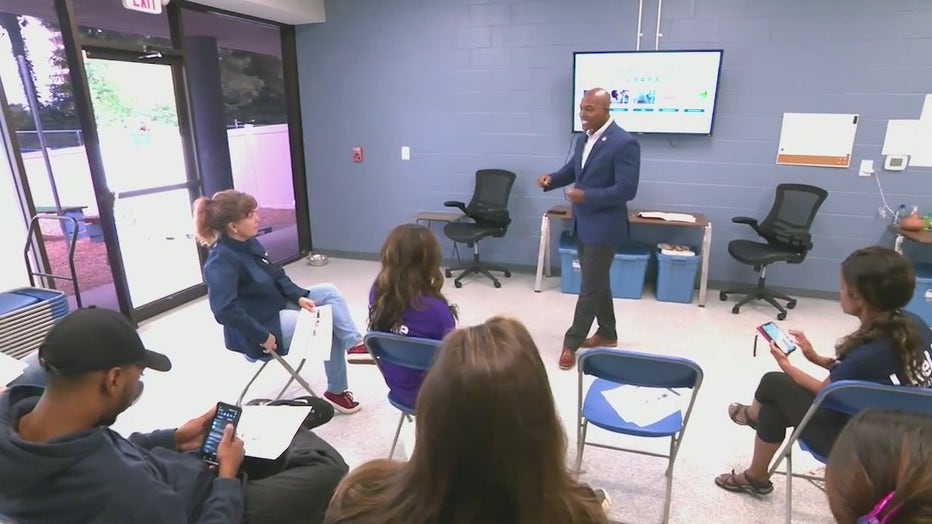
Expert Joshua Byrd leads a de-escalation class for staffers at the Lifeline Animal Project.
"So, that when you come to work you feel good, you're in a healthy state of mind, and nothing is going to rattle you easily," he tells them. "Because, if you are on edge, and you don't know it, when you do confront someone, you may explode, you may just go there."
The class members practice how to talk to someone who is angry.
Byrd says he borrows a lot from the concept of verbal judo, which he describes as a gentler way of communicating with people.
"The idea is, you use the person's energy, you use their energy almost against them, to sort of deescalate or to handle the situation," he says.
If someone is becoming angry, he says, you want to listen without reacting, and ask questions.
"There are certain phrases you might be able to use and say, namely, 'I understand you, I understand that you're frustrated. You feel like I cut you off. I'm sorry you feel that way. I didn't mean to do that, and can we move on,' instead of being combative," Byrd says. "It's tactical communication. We use it in law enforcement."
It is important to be aware of your tone, and your body language.
"You want to listen," Byrd says. "You want to exercise that empathy. You want to ask questions. You want to paraphrase, which is huge: 'I hear you saying this. Am I correct? A lot of times folks want to be listened to get things off their chest."
The goal, he says, is head off a fight before it ever begins.
"Because, again, it's not about you," Byrd says. "It's about getting out of this situation alive, safely."