

What to know about the spike in Cyclospora cases in Georgia
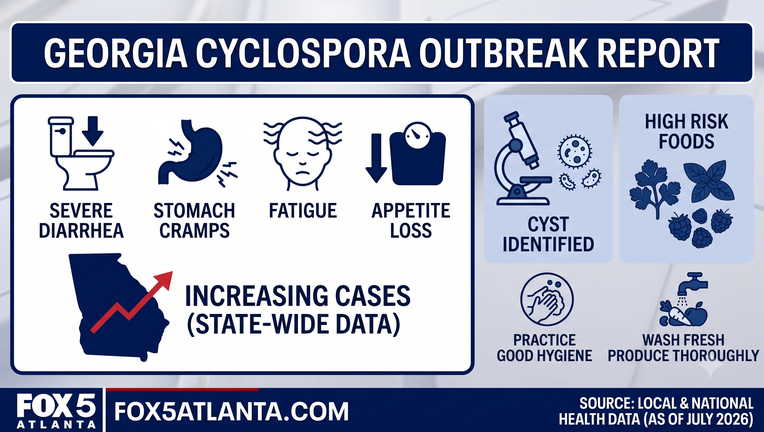
FOX 5 Atlanta graphic
ATLANTA - Georgia is seeing an uptick in cyclosporiasis cases this summer as health officials across the country investigate a growing outbreak linked to the parasite Cyclospora cayetanensis.
What we know:
According to data provided to FOX 5 Atlanta from the Georgia Department of Public Health, the state recorded between 25 and 30 cases in June, well above the typical June range of 15 to 20 cases seen from 2023 through 2025. Georgia has reported between 10 and 15 cases so far in July.
Cases acquired within the United States have also risen this year. The state saw between 20 and 25 domestically acquired cases in June, compared with the usual range of 10 to 15 cases during that month. July has brought between five and 10 domestically acquired cases.
Georgia officials: No known source in the state
What they're saying:
The Centers for Disease Control and Prevention, which is based in Atlanta, designates May 1 through Aug. 31 as "Cyclospora season" because infections routinely rise during the spring and summer months, when Americans eat more fresh produce.
Despite the increase, the Georgia Department of Public Health says it is not aware of any Georgia-specific outbreaks or clusters. Officials say there is currently no evidence tying the state's cases to a particular food item.
Nationally, investigators are still trying to determine whether cases reported in different states are connected.
National case count continues to climb
Big picture view:
As of July 9, the CDC had received reports of 843 confirmed cases in people who became sick after eating food in the United States. The agency says it is aware of more than 1,500 additional cases (mostly in Michigan) that still require analysis to determine whether they were acquired domestically.
The CDC noted that multiple states have reported more cases in recent weeks than they saw during the same period in 2025. Cases have been reported in 31 states.
Health officials caution that the federal numbers likely underestimate the true size of the outbreak because some patients recover without seeking medical care and because the CDC counts only confirmed cases. State data may include both probable and confirmed cases. The CDC says it is working with state officials to confirm and update their numbers.
RELATED: Cyclosporiasis update: 31 states now investigating diarrheal illness
The CDC, the Food and Drug Administration and state health departments are investigating several outbreaks, but no common source has been identified.
Note: Beginning July 1, 2025, it was no longer mandatory to report cases of Cyclosporiasis to FoodNet, which is the main foodborne illness surveillance arm for the CDC. At this time, states are only required to survey for Salmonella and Shiga toxin–producing Escherichia coli (STEC), which cause the largest foodborne illness outbreaks in the United States.
By the numbers:
Here is a breakdown of the numbers:
- 25–30: Estimated number of cyclosporiasis cases reported in Georgia in June 2026.
- 15–20: Average number of Georgia cases typically seen in June between 2023 and 2025.
- 10–15: Estimated number of cases reported in Georgia so far in July.
- 20–25: Estimated number of domestically acquired cases reported in Georgia in June.
- 10–15: Average number of domestically acquired Georgia cases typically seen in June.
- 843: Confirmed domestically acquired cyclosporiasis cases reported to the CDC nationwide as of July 9.
- 1,500+: Additional cases the CDC is reviewing to determine whether they were acquired in the United States.
- 31: States that have reported cases this year.
- 86: People hospitalized nationwide.
- 0: Deaths reported nationwide.
- May 1–Aug. 31: The CDC's annual "Cyclospora season."
- 2–14 days: The typical time between exposure and the onset of symptoms.
- 5–88: Age range of people with confirmed domestically acquired cases nationwide.
What is cyclosporiasis?
Dig deeper:
Cyclosporiasis is a gastrointestinal illness caused by the microscopic parasite Cyclospora cayetanensis. In the United States, infections are often linked to contaminated fresh produce, especially during warmer months.
The parasite does not spread from person to person. Foods linked to previous outbreaks include:
- Bagged salad mixes
- Cilantro
- Basil
- Raspberries
- Snow peas
- Green onions
Symptoms typically begin two days to two weeks after exposure and can include:
- Frequent watery diarrhea
- Stomach cramps and bloating
- Loss of appetite and weight loss
- Nausea
- Low-grade fever
Without treatment, symptoms can last for weeks and may come and go.
How to protect yourself
What you can do:
Health officials recommend washing fruits and vegetables thoroughly under running water, cleaning kitchen surfaces and washing hands before preparing food.
RELATED: Cyclosporiasis outbreak: How to wash produce
Researchers say Cyclospora can cling to produce more easily than many other germs, making it difficult to remove completely, but federal health agencies still recommend thoroughly rinsing fruits and vegetables before eating them.