

US captures Venezuelan president in strike: Georgians react to use of force
Secretary of State Marco Rubio clarified Sunday that the United States does not intend to manage the day-to-day governance of Venezuela, despite earlier assertions from President Donald Trump that Washington would "run" the country following the ouster of Nicolás Maduro.
Speaking on Sunday morning talk shows, Rubio sought to temper domestic and international concerns regarding a prolonged foreign intervention. He stated that the U.S. would instead utilize its existing "oil quarantine" as leverage to pressure the new leadership toward policy changes.
"And so that's the sort of control the president is pointing to when he says that," Rubio said on CBS’ "Face the Nation." "We continue with that quarantine, and we expect to see that there will be changes, not just in the way the oil industry is run for the benefit of the people, but also so that they stop the drug trafficking."

Why did the US attack Venezuela?
Georgians are reacting to the strike on Venezuela and the capture of its president as Secretary of State Marco Rubio clarifies the U.S. will not "run" the country.
Rubio clarifies ‘running’ Venezuela
What they're saying:
The secretary’s comments were a notable pivot from Trump’s statements on Saturday. During a news conference in Florida, the president vowed more than half a dozen times to "run" the oil-rich nation. "We're going to run the country until such time as we can do a safe, proper and judicious transition," Trump told reporters.
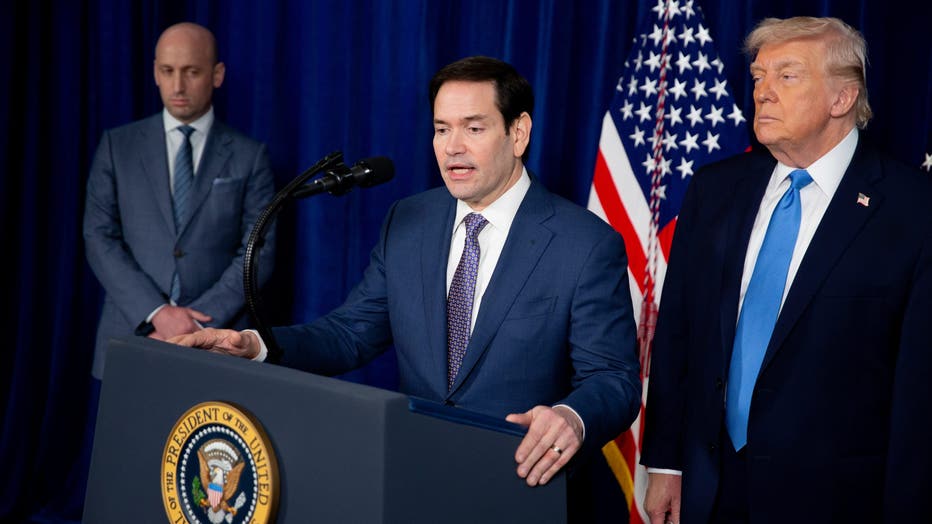
Marco Rubio, US secretary of state, speaks during a news conference at the Mar-a-Lago Club in Palm Beach, Florida, US, on Saturday, Jan. 3, 2026. President Nicolas Maduro has been charged in the US after he was captured and flown out of Venezuela, fo
Rubio argued that the president’s intent had been misunderstood by a "foreign policy establishment" fixated on past interventions in the Middle East. He emphasized that the administration would judge Maduro's subordinates, who are currently in charge, by their actions.
"The whole foreign policy apparatus thinks everything is Libya, everything is Iraq, everything is Afghanistan," Rubio said. "This is not the Middle East. And our mission here is very different. This is the Western Hemisphere."
While Rubio did not rule out a U.S. military presence, he noted that the current "force posture" is sufficient to enforce the blockade of sanctioned tankers and intercept drug trafficking.
Maduro faces federal charges in New York
What we know:
The diplomatic maneuvering follows a dramatic weekend operation, coined "Absolute Resolve," which resulted in the capture of Maduro and his wife, Cilia Flores. The couple was extracted from a military base in Caracas during a middle-of-the-night raid and flown to New York.
A video posted by the White House showed a smiling Maduro being escorted through a DEA office in Manhattan. He is scheduled to make his first appearance in federal court on Monday.
The Justice Department released a new indictment Saturday painting Maduro’s administration as a "corrupt, illegitimate government" fueled by a narco-terrorism conspiracy. "It was dark, and it was deadly," Trump said of the operation, which he kept secret from Congress to avoid leaks.
In Venezuela, Vice President Delcy Rodriguez demanded Maduro’s release, calling him the rightful leader even as the nation's high court named her interim president.
SEE ALSO: Democrat and Republican lawmakers react to US strikes on Venezuela and arrest of Maduro
Atlantans protest Venezuelan strike
The other side:
The unilateral action has sparked a polarized response. In Atlanta, protesters gathered at Piedmont Park on Sunday to march toward the North Midtown MARTA station, voicing concerns over "nation-building" and the lack of congressional approval.

Atlanta protest voices concern over Venezuela policy
Demonstrators gathered in Piedmont Park, Atlanta, expressing concern about potential U.S. involvement in Venezuela. Our Eli Jordan spoke with participants, including Matt from the Stand organization, who emphasized the importance of government actions considering both Venezuelan citizens and Americans.
"It’s the unilateral approach here of removing a head of state without congressional approval that really has us concerned about what comes next, because it feels like there might be ulterior motives here," said Matt Woodruff, a member of the organization STAND.
Critics have also questioned the administration's focus on Venezuela’s oil reserves, which are the largest in the world. Trump stated Saturday that rebuilding the country would not cost the U.S. anything because American oil companies would be tasked with the work.
Conversely, millions of Venezuelans and exiles in the U.S. celebrated the raid as a victory over an autocratic dictator. "I'm hoping for peace of all, for being able to celebrate with my family," said one exile during a rally in Florida.

Live from Brooklyn, demonstrators gathered outside the detention center holding Venezuelan President Nicolás Maduro, voicing differing opinions on U.S. involvement in Venezuela. Protesters emphasize the importance of legal and humanitarian considerations, while some call for restraint and others urge accountability.
On 1/4/25, we watched live from Brooklyn, demonstrators gathered outside the detention center holding Venezuelan President Nicolás Maduro, voicing differing opinions on U.S. involvement in Venezuela. Protesters emphasize the importance of legal and humanitarian considerations, while some call for restraint and others urge accountability.
Caribbean travel disruption
The military operation has caused significant regional disruption. Transportation Secretary Sean Duffy restricted airspace in the Caribbean and Venezuela, leading to hundreds of flight cancellations. Atlanta-based Delta Air Lines reported at least 88 cancellations to and from the country.
In Caracas, an eerie quiet fell over the city on Sunday. Businesses remained closed, and the presidential palace was heavily guarded by both military personnel and armed civilians.

Atlanta reacts to Trump’s Venezuela strike
The U.S. military launched a large-scale strike on Caracas, Venezuela, early Saturday, Jan. 3, 2026, resulting in the capture of President Nicolás Maduro and his wife, Cilia Flores.
"People are still shaken," said David Leal, 77, a Caracas resident who found his workplace empty for a second consecutive day.
The U.N. Security Council is scheduled to meet Monday to discuss the operation, which the secretary-general has described as a "dangerous precedent."
The Source: The details in this article is based on reporting by FOX News, the Associated Press, and original reporting by FOX 5 Atlanta.