

Spotted lanternfly: Officials on the lookout for invasive insect across Georgia
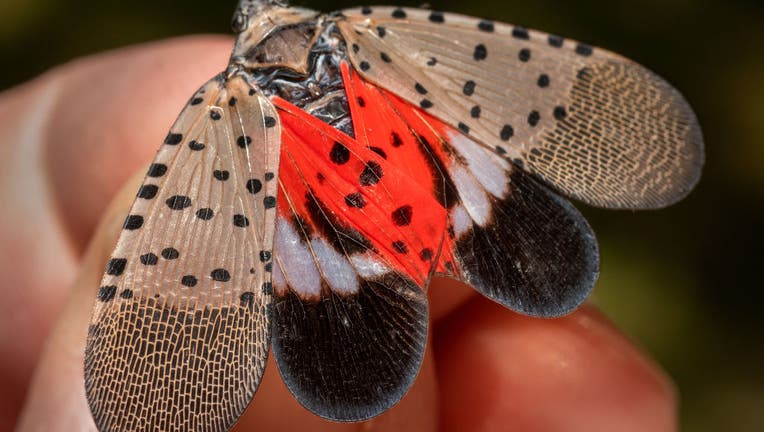
Vince Burkle, of the Indiana Department of Natural Resources, holds an adult spotted lanternfly found in Huntington, Indiana, on Aug. 17, 2022. (Andy Lavalley/Post-Tribune/Tribune News Service via Getty Images)
FULTON COUNTY, Ga. - Officials are asking Georgians to keep an eye out for a new invasive insect that has made its way to the Peach State.
The Georgia Department of Agriculture and the University of Georgia are urgently searching for any signs of the spotted lanternfly to make sure the pest doesn't make itself at home.
What we know:
A native of Asia, the spotted lanternfly was first identified in the United States in 2014, in Berks County, Philadelphia. It’s likely that insect eggs came over with a load of landscaping stones. After more than a decade, there are reported infestations in more than a dozen states, mostly on the East Coast. In Georgia, the first live population of the insect was found in Fulton County in October 2024, and remains the only known presence of the pest in the Peach State.
The insect has been able to spread so far, so quickly, because it is a stealthy hitchhiker. Drivers this time of year unwittingly give lifts to adults, which look like moths, perched inside trunks, on wheelwells, or on bumpers.
People also unknowingly transport spotted lanternfly eggs, which are laid later in the season. Females leave masses of 30 or more eggs on all sorts of surfaces, from tree trunks to patio furniture. Eggs laid on portable surfaces, like camping trailers and train cars, can hatch in the spring many miles away.
Juvenile spotted lanternflies are back with white spots that turn red as they get older. Once they mature, they have brown forewings with black spots at the front and a speckled band at the rear. Their hind wings are bright scarlet with black spots at the front and white and black bars at the rear.
The Georgia Department of Agriculture says that both the younger and older lanternflies gather in large numbers while feeding and can be easier to spot and dusk or night on plants.
Why you should care:
Researchers at the University of Georgia say the lanternfly eats more than 70 plant species, including many that are economically important to the state's farmers.
The pest also leaves behind a fluid known as honeydew that attacks mold and can be difficult to remove.
"The impact on Georgia’s agriculture, forestry and nursery industries could be significant, posing a serious economic burden across multiple sectors," the university wrote.
What you can do:
Georgia officials are asking anyone who sees a spotted lanternfly to take a clear picture of the bug, kill it as soon as possible, and report the sighting to the Department of Agriculture.
The Source: Information for this report came from the Univeristy of Georgia, Georgia Department of Agriculture, previous FOX 5 reporting, and the Associated Press.