

Federal judge to hear request to block Georgia's gender-affirming care ban

Law bans gender-affirming care for children
A law blocking minors from receiving most gender-affirming surgeries and hormone therapies is officially in place. The law passed along party lines this year. Gov. Kemp signed it into law in March. Here's what SB 140 entails.
ATLANTA - A federal judge will hear an emergency request by the families of four transgender children to block a new Georgia law that bans minors from receiving most gender-affirming surgeries and hormone replacement therapies.
Senate Bill 140 went into effect Saturday, but not before the families filed a lawsuit arguing the law prevents them from making critical decisions about their children's healthcare.
The law passed along party lines this year by the Republican-majority General Assembly and signed by Republican Gov. Brian Kemp was hotly contested, with Democrats, parents and medical providers making impassioned arguments against it. Georgia is one of at least 20 states that have enacted laws that restrict or ban gender-affirming medical care for transgender minors, with most currently facing lawsuits.
The Georgia law does allow doctors to prescribe puberty-blocking medications, and it allows minors who are already receiving hormone therapy to continue.
Lawmakers in support of the legislation say these treatments have lifelong effects young people may not recognize.
"The bill again does not stop adults from making an informed decision that's going to impact their adult life," Rep. Will Wade explained in March.
But opponents say it will have devastating effects on young people, who are making decisions under parental and medical supervision. They argue the law further marginalizes people who are already prone to taking their own lives at disturbingly high rates.
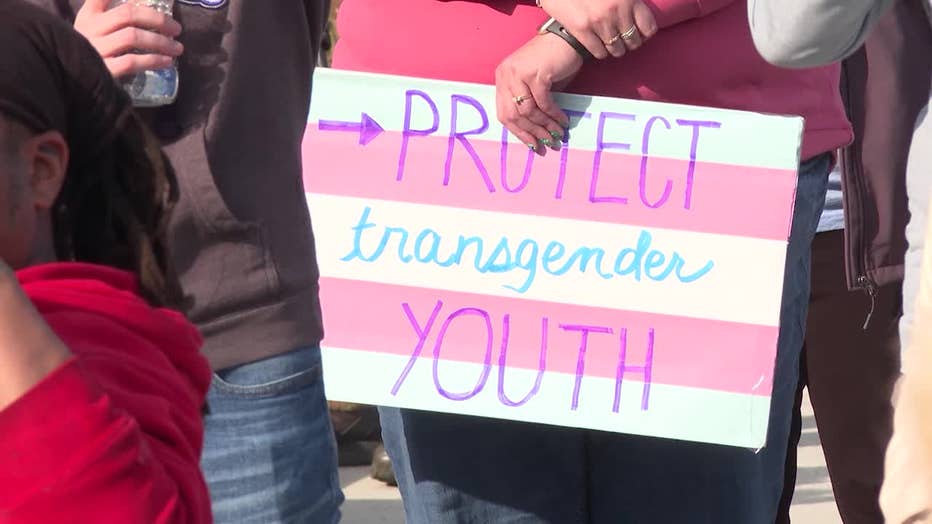
Demonstrators show their opposition to SB 140 during a protest in front of the Georgia Capitol on March 30, 2023. (FOX 5)
"It does not protect youth. It harms youth," Beth Littrell, an attorney with the Southern Poverty Law Center, said.
The families, all with children 12 and under, say hormone therapy is a necessity for their kids who are all diagnosed with gender dysphoria. They entered the lawsuit anonymously over fear for their safety. They say not having the treatment will cause "increased distress, major depression, anxiety, self harm, suicidal ideation, and suicide."
"These families feel they are targeted. And all they're trying to do is to raise happy healthy children who can thrive and be their authentic selves and get whatever medication their doctors and they decide their children need," Littrell explained.
The families along with attorneys for the Southern Poverty Law Center, ACLU, and Human Rights Campaign Foundation now want a temporary restriction in place to stop SB 140.

Kemp signs bill banning some gender-affirming care for trans youth
Gov. Brian Kemp signed a bill into law which would prevent medical professionals from giving transgender children certain surgical treatments.
With the law now in effect, young people already on puberty blockers will not be able to proceed to hormone therapy. That means they will have to choose between the negative consequences of prolonged use of that medication or stopping the medication and going through puberty to develop secondary sex characteristics that do not match their gender identity, the lawsuit says.
For those not already on puberty-blocking medication, the law discourages doctors from prescribing it at all because allowing a young person to take such medication until they turn 18 "is not a viable option under the appropriate standards of care," the lawsuit says.
The lawsuit is the latest to target bans on gender-affirming care, after a wave of legislation passed in conservative-led states.
A federal judge struck down Arkansas' ban as unconstitutional, and federal judges have temporarily blocked bans in Alabama, Indiana, Kentucky and Tennessee. Oklahoma has agreed to not enforce its ban while opponents seek a temporary court order blocking it. A federal judge has blocked Florida from enforcing its ban on three children who have challenged the law.
The states that have enacted laws restricting or banning gender-affirming medical care for transgender minors: Alabama, Arkansas, Arizona, Florida, Georgia, Idaho, Indiana, Iowa, Kentucky, Mississippi, Missouri, Montana, Nebraska, North Dakota, Oklahoma, Tennessee, Texas, Utah, South Dakota and West Virginia.
The Associated Press contributed to this report.