

Fulton commissioner cites law in rejecting GOP nominees
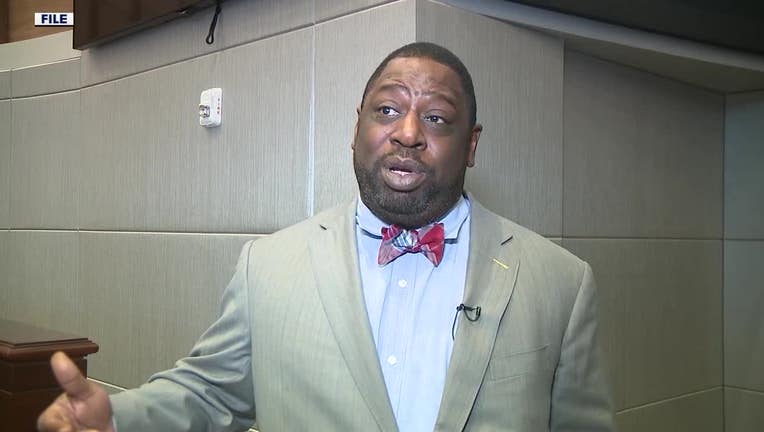
Fulton County District 5 Commissioner Marvin Arrington Jr. (FOX 5)
FULTON COUNTY, Ga. - Fulton County Commissioner Marvin S. Arrington Jr. said Wednesday he will not be compelled to support Republican nominees to the county’s Board of Registration and Elections, a matter set to appear on the Commission’s agenda later in the day.
What we know:
In a lengthy statement, Arrington argued that the law requires four affirmative votes from commissioners before any action can be taken. He cited U.S. Supreme Court precedent, Georgia law and Fulton County code in his explanation, saying that nominations and appointments are separate processes.
"The law requires four affirmative votes for the board of commissioners to take official action," Arrington said. "Unless there are four affirmative votes, the county is legally unable to act."
The Fulton GOP has sued after two of its nominees — Julie Adams and Jason Frazier — failed to secure approval. Arrington characterized the lawsuit as an attempt to alter the established process after the fact. He pointed to examples at the state and federal level where nominees from both parties were withdrawn or rejected, calling it part of the normal system of checks and balances.
Background materials released with Arrington’s statement noted that commissioners cannot be legally compelled to vote for or against a particular nominee, and that failed nominations are a routine occurrence. The statement also argued that requiring approval of specific candidates would intrude on commissioners’ discretion and First Amendment rights.
The Commission has twice voted on the nominations and filed them without action. According to Arrington, the Fulton GOP should submit new names for consideration, consistent with county procedures.
PREVIOUS STORIES
- Judge halts $10,000-a-day fine in Fulton County election board dispute
- Judge rules Fulton County election board members in contempt
- Fulton commissioners to respond to GOP lawsuit over election board nominees
- Republicans suing Fulton County leaders over election board nominees
- Raffensperger slams Fulton County for defying order on elections board
- Fulton commissioners defy order to seat Republican election board nominees
- Fulton County must confirm Republican election board nominees, judge rules
- Georgia appeals court upholds ruling saying election officials must certify results
What they're saying:
Read Arrington's full statement:
Friends, let me explain this as plainly as I can. We did not invent this process. The system of nomination and appointment is written into our laws—the U.S. Constitution, the Georgia Constitution, and even the Fulton County Code. The Supreme Court told us long ago in Marbury v. Madison: nomination is not the same as appointment. And in NLRB v. SW General, the Court said again, a nominee does not hold office until the process is complete.
Georgia law follows the same rule. The governor nominates, but the state senate must confirm. If rejected, that person cannot be resubmitted for one year. That’s how the system is designed. Here in Fulton County, our own code says it directly. Section 1-73(d) of the Fulton County Code provides: ‘Four members of the board of commissioners shall constitute a quorum for the transaction of business, but the affirmative vote of at least four commissioners shall be required for the board of commissioners to take official action.’ That means unless there are four affirmative votes, the County is legally unable to act.
Now, because the Fulton Republican Party’s nominees failed, the Party has filed a lawsuit. But that lawsuit is nothing more than an attack on democracy and an attempt to move the goal posts after the fact. They don’t like the result, so they want to change the rules.
But history shows us what happens when nominations fail—and in both parties. For example, in Washington, in 2021, Democrat Neera Tanden was nominated by President Joe Biden to serve as director of the Office of Management and Budget (OMB). However, her path to confirmation fell apart due to mounting opposition and likely Senate rejection, so Biden nominated someone else who was confirmed. And on rare occasions, nominees are voted down altogether, like Judge Robert Bork. In 1987. President Ronald Reagan nominated Bork, but the Judiciary Committee, then headed by Senator Joe Biden, rejected his nomination, and the full Senate voted not to confirm Bork. After his nomination failed, Reagan nominated Anthony Kennedy, who was confirmed and appointed and served the Court until retiring a few years ago, and was replaced when President Donald Trump’s nominee, Brett Kavanaugh, was confirmed by the Senate.
That’s not dysfunction, that is democracy. Failed nominations are part of the process. It ensures accountability. It ensures that no one group or party can impose its will without the people’s consent.
So let me say it again: nominations may come from outside groups, but appointments only happen when your elected representatives give their consent. And in Fulton County, if there are not four affirmative votes, the nomination fails. That is the law. That is democracy at work.
What's next:
The dispute comes as commissioners continue to navigate how to fill the county’s election board seats, with legal challenges pending in court.