

Charles Hosch disappearance: Memorial planned for missing hiker
Courtesy of Hosch & Morris law firm
ATLANTA - Nearly 10 months after a Texas attorney and law professor disappeared while hiking on one of Georgia's best-known mountains, his family is preparing to gather for a memorial service.
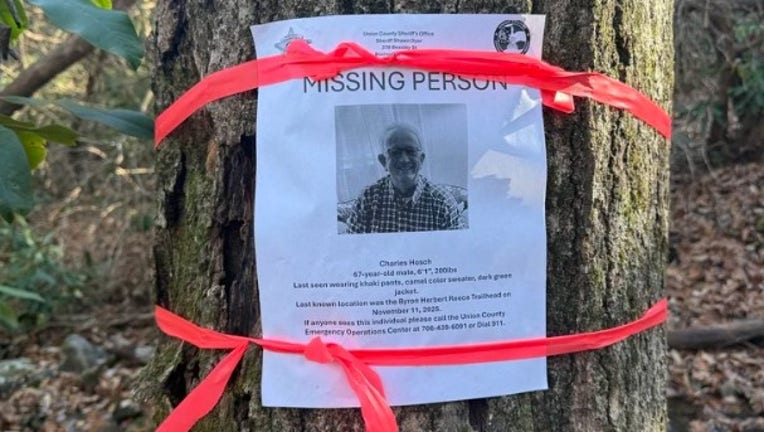
Charles M. Hosch, 67, was last seen Nov. 11, 2025, while hiking on Blood Mountain in Union County. Hosch, an attorney and adjunct professor at Southern Methodist University's Dedman School of Law, grew up in Gainesville before eventually moving to Texas.
His family says a memorial service will be held at 11 a.m. Sept. 19 at University Park United Methodist Church in Dallas.
Hosch had returned to a mountain that held deep meaning for him and his family. On the afternoon he disappeared, Hosch parked near the Byron Herbert Reece Trail and hiked to the Appalachian Trail and then toward the summit. Two witnesses encountered him near the top and later told authorities he appeared to be heading back down the mountain. He was never seen again.
An extensive search with no answers
What we know:
Hosch's disappearance triggered an unusually large search involving local, state and federal agencies, along with volunteers and members of his family.
The initial search lasted about two weeks, with some days stretching as long as 18 hours. More than 250 personnel searched the mountain as helicopters and drones flew overhead. Searchers sometimes crawled on their hands and knees to look beneath thick vegetation.
A later coordinated search brought more than 70 professional search-and-rescue members from Georgia, Alabama, North Carolina and Tennessee to Blood Mountain. K9 teams, drones and crews equipped with ropes to rappel down cliffs joined the effort, along with about 50 additional volunteers.
Despite the effort, authorities have reported finding no verified trace of Hosch or the items he carried with him.
Searchers have described Blood Mountain as particularly difficult terrain. Dense brush and rhododendron can hide the ground, while boulders, cliffs and rocky outcroppings create spaces that are difficult to see and search.
RELATED STORIES
- Texas law professor missing in North Georgia mountains
- New nonprofit joins search for missing Texas attorney near Blood Mountain
- Family not giving up hope in search for missing Texas lawyer
- Search continues for Texas law professor on Georgia's Blood Mountain
- Formal searching for professor missing from Blood Mountain ends
Blood Mountain's history
The backstory:
At about 4,461 feet, Blood Mountain is the highest point on the Appalachian Trail in Georgia and the state's sixth-highest mountain.
Its name has long been tied to local lore about a battle between Cherokee and Muscogee Creek warriors. The Georgia Historical Society says the mountain may have been named for such a battle, although the source material provided by Hosch's family notes historians have found no definitive record of the legendary bloody clash described in local folklore.
Blood Mountain also has a darker modern history. In 2008, 24-year-old hiker Meredith Emerson was abducted from the area by Gary Michael Hilton and later killed. Local authorities, however, more commonly respond to hikers suffering injuries, medical emergencies or becoming lost.
How often do hikers go missing?
Dig deeper:
There is no comprehensive national database that provides an exact number of hikers who disappear in the United States each year. The National Park Service says people can become missing for numerous reasons, including getting lost or disoriented, suffering an accident or being delayed by severe weather.
The broader search-and-rescue numbers illustrate how frequently wilderness emergencies occur. The National Park Service responds to approximately 4,500 search-and-rescue incidents each year across the park system, requiring an estimated 50,000 to 100,000 personnel hours. Those incidents include lost and injured hikers as well as other emergencies, so the figure should not be interpreted as 4,500 missing hikers.
For Hosch's family, however, the mystery remains. Nearly 10 months after he walked onto Blood Mountain, there has been no confirmed evidence explaining what happened to him.
His family will gather in Dallas next month to remember him even as his disappearance remains unresolved.