

Childhood cancer diagnosis brings Woodstock family even closer

Woodstock family pushes through cancer together
The Connor family from Woodstock, Georgia would tell you they're "grateful" for the success they've had so far in their daughter Caroline's cancer diagnosis, and hopeful for what the future may bring.
WOODSTOCK, Ga. - Camille and Bob Connor and their kids have learned to soak in life's smaller moments, like hanging out together at their Woodstock home.
"You're grateful for people around you, and appreciative of just being given another day," Camille Connor explains. "At the drop of a dime, life can change, and it has."
Their lives changed in 2015.
"I remember like it was yesterday," Connor says.
Their son Stafford, who is now 12, was almost 3.
Caroline and Carson, who are identical twins, had just turned 1.
Caroline had developed earaches, her mother says, and she was not eating or thriving like her sister.
"They thought she was having an ear infection," Camille Connor says. "But, our pediatrician was amazing and recognized some symptoms that we would never know to pick up on."
A few days after the twins celebrated their first birthday, Caroline went in for an MRI.
"That's when it was revealed that she had a brain tumor," Bob Connor says.
At Children's Healthcare of Atlanta, doctors ordered more scans.
"She was diagnosed with a pediatric juvenile pilocytic astrocytoma, grade one," Camille Connor says.
The Connors were told that the type of tumor, a low-grade pediatric JPA, is rare in children, and is usually benign and slow-growing, unlikely to spread to surrounding tissue.
Caroline Connor's tumor was on her optic nerve, making surgery risky.
So, their oncologist recommended chemotherapy.
"She said, 'Don't compare your story to anybody else's story, and make sure you don't Google,'" Camille Connor remembers.
The couple took that advice to heart, and decided to stay focused on the road ahead of them.
The first chemo did not work, Connors says, and about six months later, Caroline began to regress physically.
"Her coordination, ability to walk [were off], all the things you would associate with hydrocephalus," her father says. "It was affecting her quality of life pretty clearly."
That's when their Children's Healthcare team recommended brain surgery, a 12-hour procedure to remove as much of the tumor as was safely possible.
Almost immediately, the Connors say, the operation seemed to help.
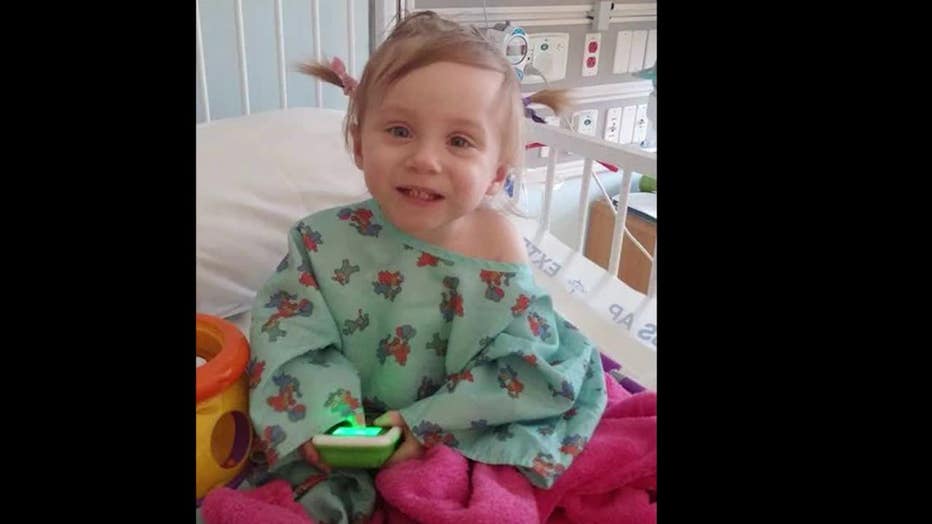
Photo submitted by family
"Recovery was rough, but I don't think there was a moment, I don't think a day passed by, that we weren't incredibly grateful that we had had such success with that surgery," Bob Connor says.
Because of where the tumor was located, the surgeon had to leave some of it intact.
So, after a short break from treatment to recover from the operation, Caroline Connor began receiving a new chemotherapy drug.
"Then, it was followed by an MRI, and everybody was scratching their eyebrows a little bit, because we found that the tumor had metastasized," Camille Connor says. "[There was a] 3-percent chance that this type of tumor, with this at this grade, metastasizes."
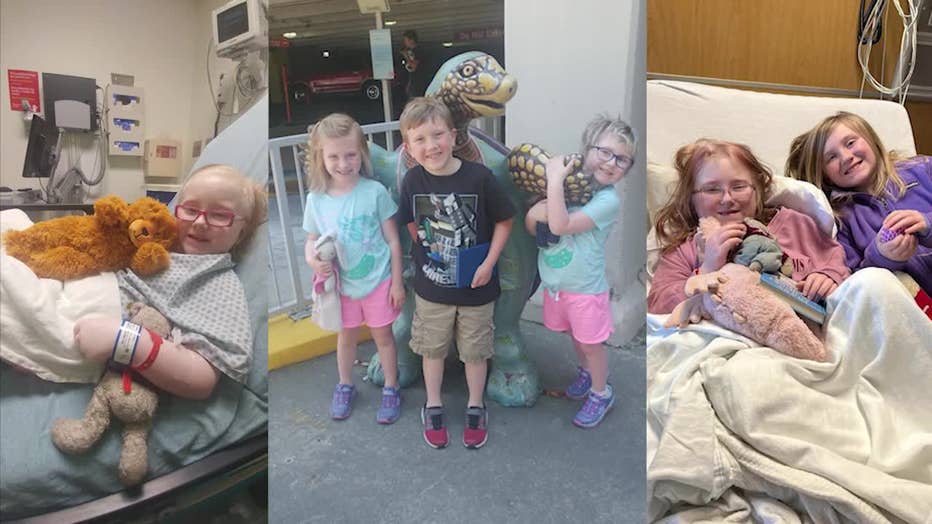
Still, Caroline pushed on through eight and a half years of chemotherapy, immunotherapy, tumor and shunt surgeries, and experimental treatments.
"But, we also have an amazing medical group that I mean, honestly, they answer calls, they get back to us, they care," her mother says.
The family has learned to stick with treatments that seem to be working, then push forward to find another option when they stop working.
"We are out of traditional options," Camille Connor says.
Now in the fifth grade, Caroline is receiving a promising new medication known as a MEK inhibitor at Duke University, one of only two pediatric centers in the U.S. offering the treatment.
Photos submitted by family
"It looks like we're starting to actually see some reduction in mass, which has been the first time," Bob tells FOX 5.
Caroline goes in for brain MRI scans every few months.
Her latest, on Jan. 16, showed the tumor was stable, her parents say.

The Connor family.
So, the Connors are taking things one day at a time, thankful for the support they have found from all around them.
"We landed here in a place where we have an amazing medical community, an amazing church community, an amazing school community," Camille Connor says. "You see a different side of people, and it makes you feel grateful. I feel grateful a lot."