

New robotic clothes allow you to suit up hands-free

Robotic clothes allow you to suit up hands-free
Researchers at Stanford University and South Korea’s KAIST have developed a soft-robotic technology that allows users to put on protective clothing hands-free and in seconds. (Credit: Stanford University and South Korea’s KAIST)
Researchers at Stanford University and South Korea’s KAIST have developed a soft-robotic technology that allows users to put on protective clothing hands-free and in seconds.
According to Reuters, the technology could open new doors for emergency responders, semiconductor workers and people with mobility challenges.
Robotic clothes
Big picture view:
The system, inspired by climbing ivy, uses flexible, air-pressurized "vines" embedded directly into fabric. When activated, the vines inflate and extend at their tips, guiding the garment over the person’s body, even if they’re moving.
The study was published in the peer-reviewed journal IEEE Robotics and Automation Letters.
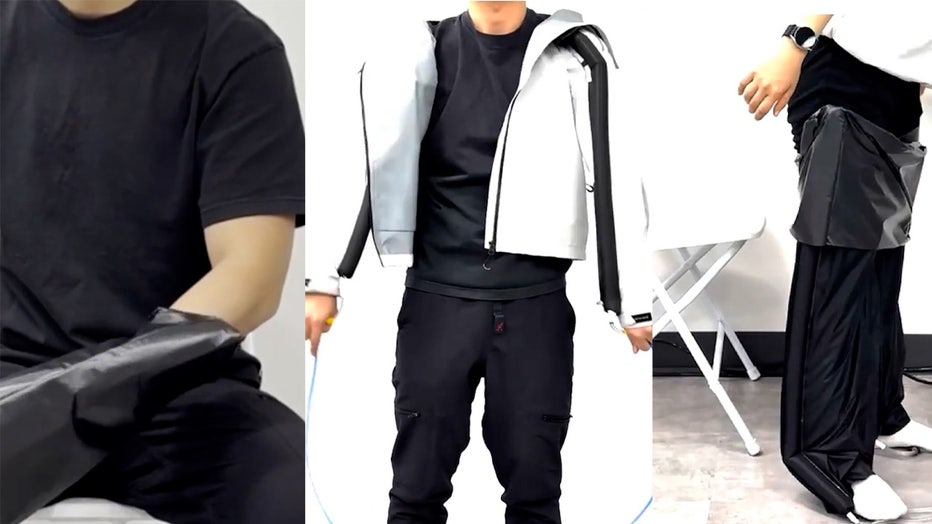
Researchers have developed a soft-robotic technology that allows users to put on protective clothing hands-free and in seconds. (Stanford University and South Korea’s KAIST)
What they're saying:
"The vine robot stays close to the person and dresses them by turning the clothing inside out as it moves, allowing it to climb stably along the shape of the body," Kim Nam Gyun, a postdoctoral researcher at KAIST and lead author of the paper, told Reuters.
Kim said the concept came to him while he was riding a bicycle and it started to rain.
"I thought it would be helpful if a raincoat could be put on automatically," he recalled.
MORE: Let them eat... duct tape? See this Bay Area student's viral duct tape prom dress
The full dressing process takes about 10 seconds. Unlike conventional robotics, which require complex control algorithms and precise positioning, the self-dressing system adapts dynamically to the human body, Kim said.
"It can pass through narrow gaps, grow while adapting to the shape of its surrounding environment, and move regardless of whether the surface is slippery, sticky, or sloped," said Ryu Jee-Hwan, a professor of civil and environmental engineering at KAIST and co-author of the study.
Dig deeper:
Researchers see immediate benefits for elderly or disabled individuals needing daily assistance, but they also see other critical needs. The hands-free system could streamline process times for workers stepping into semiconductor clean rooms or allow first responders to rapidly suit up in personal protective equipment (PPE) during chemical or hazardous emergencies.
MORE: Here's how often AI ‘doctors’ get things wrong, according to human experts
Ryu noted that while artificial intelligence software often dominates current engineering headlines, this project highlights the essential role of physical design.
"It's a clear example of how mechanical innovation can solve complex real-world challenges directly," Ryu said.
The Source: This report includes information from Reuters.