

Artemis II live tracker, day 7: Astronauts returning to Earth after historic lunar flyby
The Artemis II crew and the Orion spacecraft are now making the 200,000+ mile journey back to Earth after completing its historic flight around the moon.
Artemis II lifted off from Kennedy Space Center in Florida on April 1, and is expected to splash down off the coast of California, near San Diego, on April 10.
NASA astronauts Reid Wiseman, Victor Glover, Christina Koch, and Canadian Space Agency astronaut Jeremy Hansen spent several hours on the Orion spacecraft observing and photographing parts of the moon's surface never before seen by human eyes on Monday.
Here are some of the latest updates from Day 7 of Artemis II's moon mission – and return to Earth.
First images of the moon from Artemis II flyby
NASA astronauts to talk with journalists on Wednesday
NASA's Artemis II astronauts will join journalists for a virtual media call on Wednesday, April 8. That call is scheduled to start at 9:45 p.m. and last about 20 minutes, NASA said. It will also be streamed on their YouTube channels.
When will Artemis II return to Earth?
It will take the crew about four days to make the trip back to Earth. They are expected to splash down in the Pacific Ocean on Friday, April 10, near San Diego.
Key moments from Monday's lunar flyby
During Monday's lunar flyby, Artemis II's crew recommended naming one of two craters on the lunar surface after Commander Reid Wiseman's late wife, Carroll.
The other crater was named Integrity, after the name the crew gave the Orion spacecraft.
Artemis II also traveled more than 250,000 miles from Earth, breaking the record for the greatest distance humans have traveled from the planet, which was set by Apollo 13 in 1970.
Artemis II mission timeline
Artemis II launched from Kennedy Space Center on April 1, sending the four astronauts aboard the Orion spacecraft on a 10-day journey to the moon and back to Earth.
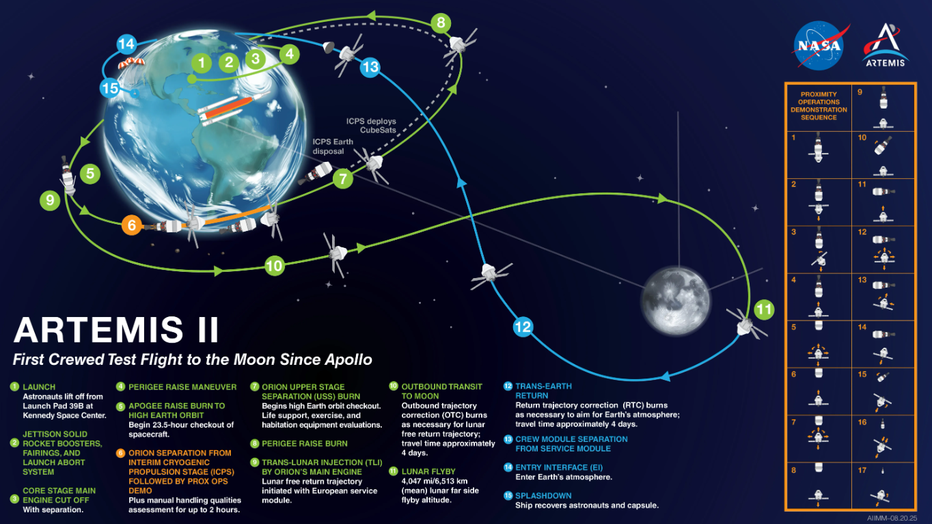
An illustration showing the Artemis II mission. Credit: NASA
- Earth orbit (Day 1): The Artemis II astronauts will orbit Earth for one day to confirm all spacecraft systems are functioning properly.
- To the moon (Days 2–5): Orion’s main engine will fire to propel the capsule out of Earth orbit toward the moon, roughly 244,000 miles (393,000 kilometers) away.
- Moon flyby (Day 6): Orion will reach its farthest point from Earth, passing about 5,000 miles (8,000 kilometers) beyond the moon. Astronauts are expected to document the flyby with cameras and smartphones before heading back to Earth.
- Return (Days 6–9): Using a free-return trajectory, Orion will use the moon’s and Earth’s gravity to guide the spacecraft safely home.
- Reentry: The service module separates, and the capsule re-enters Earth’s atmosphere, facing temperatures up to 3,000°F (1,650°C).
- Splashdown: The Artemis II crew will parachute into the Pacific Ocean, completing the mission much like Apollo astronauts did decades ago.
Artemis II live tracker
NASA has created the Artemis Real-time Orbit Website (AROW), where people can track the Orion spacecraft in real time. Click here to see where the spacecraft and the Artemis II astronauts are.
Views from space: NASA video feed from Orion spacecraft
NASA is also broadcasting a feed from the Orion spacecraft. Viewers can get live views of space during the crew's trip.
The feed is expected to end shortly before the Orion splashes down in the Pacific Ocean, according to NASA.
The Source: This article was written with information from NASA, the Artemis Real-time Orbit Website (AROW), and live feeds from NASA's YouTube channel.