

2026 Hurricane Season: Colorado State forecast calls for near-average storm count

2026 Hurricane Season: Colorado State forecast calls for near-average storm count
The transition to a robust El Niño is the primary reason for the quieter forecast, as it increases wind shear that suppresses storms.
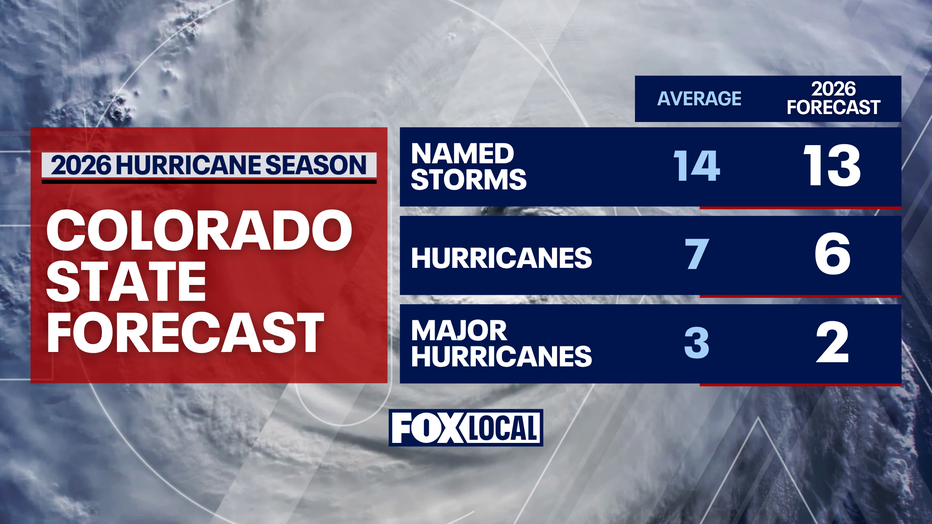
ATLANTA - Researchers at Colorado State University have released their initial forecast for the 2026 Atlantic hurricane season, which runs from June 1 to November 30. The team expects a somewhat below-average season, predicting 13 named storms.
What we know:
Of these, six are expected to become hurricanes, and two are predicted to reach major hurricane strength (Category 3 or higher).
This forecast suggests the season will be about 75% as active as a typical year based on long-term averages. For the first time, researchers used an artificial intelligence-based climate model called ACE2 to help confirm these predictions, which align with other traditional computer models.
Big picture view:
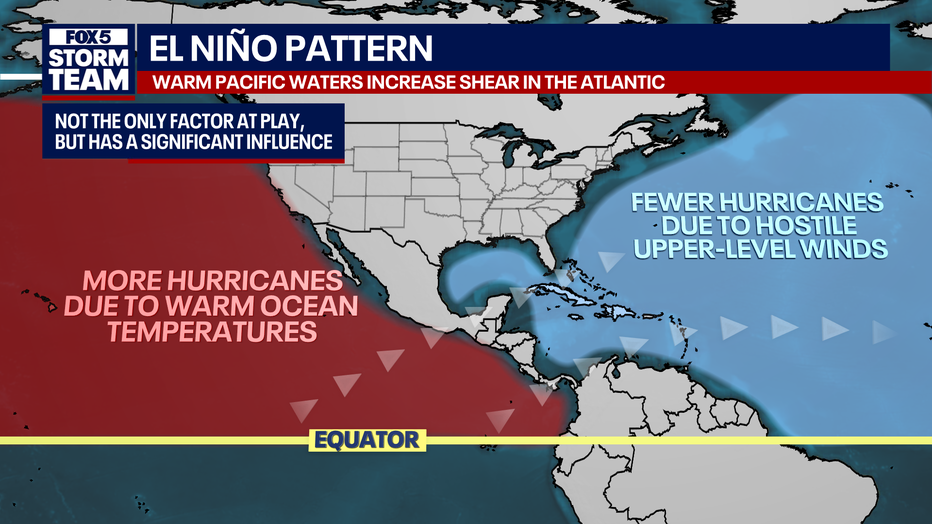
The dominant factor for the 2026 season is the expected development of El Niño. While the Pacific currently has weak La Niña conditions, a rapid transition to El Niño is forecast for the peak of the season. The speed of that transition could also have an impact on the season, particularly if it's any slower than forecasted.
How El Niño affects hurricanes: When the Pacific Ocean warms up, it changes global wind patterns. Specifically, it increases upper-level westerly winds that blow across the Caribbean and into the Atlantic. This creates vertical wind shear, which acts as a deterrent to hurricanes. High wind shear effectively tilts or "blows the tops off" developing storms, preventing them from organizing or intensifying. Because this year's El Niño is expected to be moderate to strong, scientists believe the resulting wind shear will significantly limit storm activity despite warm waters in the western Atlantic, especially as the season wears on.
While El Niño is famously known as a "hurricane killer" in the Atlantic due to the high wind shear it creates, record-breaking ocean warmth can effectively override this atmospheric brake. Think of it as a tug-of-war between the air and the sea: the atmosphere tries to tear storms apart, but the ocean provides so much raw energy that some storms can still explode in intensity.
The backstory:
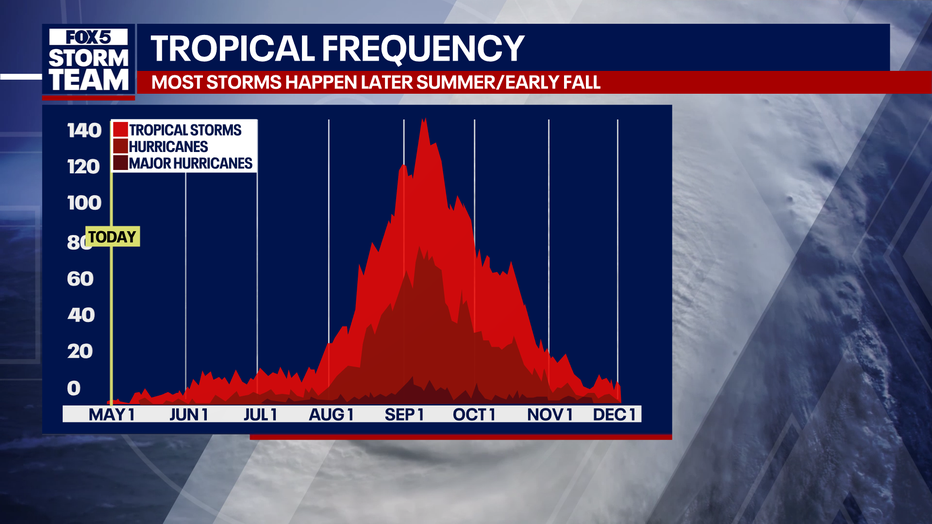
Last year, the 2025 hurricane season was more active, finishing at 105% of the average. While it also had 13 named storms, the distribution was unusual: there were only five hurricanes, but three of them reached Category 5 intensity (Erin, Humberto, and Melissa).
Understanding the 2025 "Lull": Even though 2025 was an above-normal year, it experienced a strange peak-season lull from August 29 to September 16, a time when activity is usually highest. Analysis shows this was caused by:
- Dry and Stable Air: Northerly winds brought dry air from higher latitudes into the tropics, suppressing cloud growth.
- Upper-Level Trough (TUTT): A cold low-pressure system near Hispaniola increased wind shear during the lull.
- African Subsidence: Sinking air over West Africa weakened the "seed" waves that typically grow into hurricanes.
Once these factors cleared in late September, Hurricane Melissa formed and became one of the strongest hurricanes on record, causing $9 billion in damage and 95 fatalities in the Caribbean.
Local perspective:
For Georgia, the statistical outlook for 2026 is encouraging compared to historical data.
- Named Storms: There is a 49% chance of a named storm tracking within 50 miles of Georgia this year, which is lower than the long-term average of 63%.
- Comparison to 2025: At this time last year, the probability for a storm tracking near Georgia was much higher at 72%.
- Major Hurricanes: The chance of a Category 3+ hurricane passing near Georgia is only 4% (compared to a 6% average).
While these percentages are lower, residents should remember that storms making landfall anywhere on the Gulf or East Coasts can still bring significant flooding and wind damage far inland to cities like Atlanta.
By the numbers:
- 13: Predicted named storms for 2026.
- 2: Predicted major hurricanes (Category 3-4-5).
- 75%: How active the 2026 season is expected to be compared to the long-term average.
- 185 mph: The peak wind speed of Hurricane Melissa in 2025.
- 32%: The probability of a major hurricane hitting any part of the continental U.S. coastline this year.
What you can do:
Meteorologists warn that seasonal forecasts are based on probabilities, not certainties. Even in a quiet year, it only takes one storm hitting your community to make it a disaster.
- Develop an Emergency Plan: Know where your family will go and how you will communicate if a storm approaches.
- Build a Kit: Ensure you have enough food, water, and medicine for at least three days.
Stay Informed: Follow local weather updates, as the CSU team will issue revised forecasts in June, July, and August.
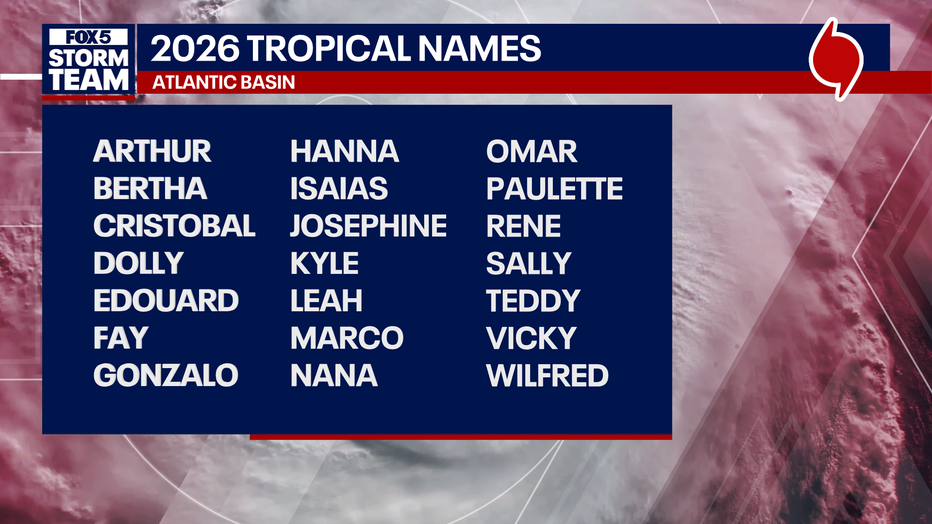
Names for 2026
- Arthur
- Bertha
- Cristobal
- Dolly
- Edouard
- Fay
- Gonzalo
- Hanna
- Isaias
- Josephine
- Kyle
- Leah
- Marco
- Nana
- Omar
- Paulette
- Rene
- Sally
- Teddy
- Vicky
- Wilfred
The Source: This report is based on findings from the Colorado State University (CSU) Tropical Meteorology Project. This research team, led by Dr. Phil Klotzbach and established 43 years ago by Dr. Bill Gray, uses nearly 40 years of historical data and advanced machine learning to predict hurricane activity. Additional information came from the National Hurricane Center.