

Trump's plan to seize Venezuela's oil is an uphill battle: Here's why

Trump: US will look to tap Venezuelan oil reserves
President Donald Trump said the U.S. will "run" Venezuela during a political transition following the capture of Nicolas Maduro and his wife. Trump said the US will look to tap Venezuelan oil reserves. Matthew "Whiz" Buckley, a retired Navy fighter pilot joined LiveNOW from FOX's Josh Breslow to discuss the implications of it all.
President Donald Trump's plan to "run" Venezuela and take over the country’s vast oil reserves likely won’t impact oil and gas prices in the short-term, experts warn.
Oil companies are still assessing what Trump’s stunning announcement means for the industry. Trump said U.S. military forces conducted a large-scale strike on Venezuela early Saturday morning, capturing the country’s president Nicolás Maduro and his wife, Cilia Flores. Both were taken by warship to the U.S. to face narco-terrorism charges.
Trump also said the U.S. government would help run the country while American oil companies fix Venezuela’s long-neglected oil infrastructure and bring oil production back to historic levels. Here’s why industry experts say that’s a tall order.
RELATED:
Venezuela’s ‘decaying’ oil infrastructure
By the numbers:
Venezuela holds 303 billion barrels – or roughly 17% – of global oil reserves, the largest proven reserve of any country. But even with the massive reserves, Venezuela has been producing less than 1% of the world's crude oil supply. Corruption, mismanagement and U.S. economic sanctions saw production steadily decline from the 3.5 million barrels per day pumped in 1999 to the 1.1 million barrels currently pumped each day.
RELATED:
International oil companies have good reason to be interested in Venezuela, but it could take several years and major investments before production significantly increases.
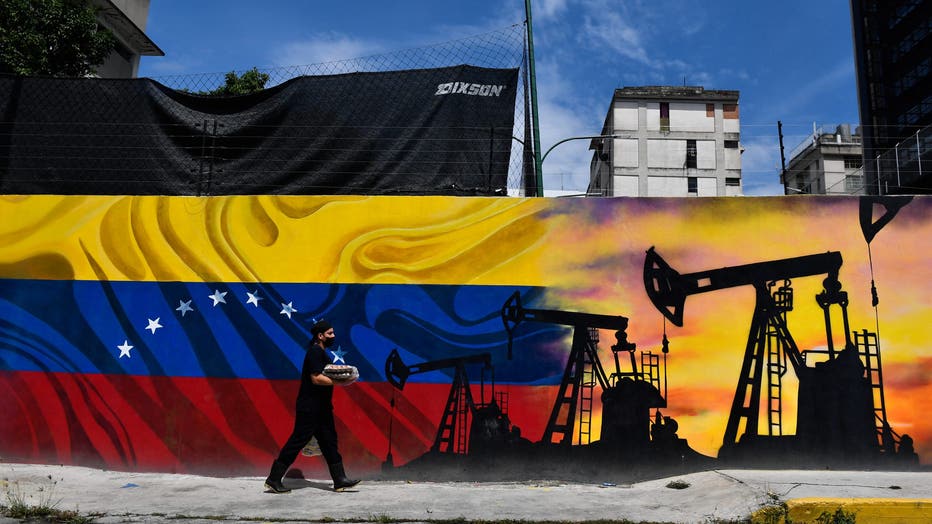
FILE - A man wearing a face masks walks past a mural depicting an oil pump and the Venezuelan flag in a street of Caracas, on May 26, 2022. (Photo by FEDERICO PARRA/AFP via Getty Images)
What they're saying:
"While many are reporting Venezuela’s oil infrastructure was unharmed by U.S. military actions, it has been decaying for many many years and will take time to rebuild," Patrick De Haan, lead petroleum analyst at gasoline price tracker GasBuddy told The Associated Press.
"The estimate is that in order for Venezuela to increase from one million barrels per day — that is what it produces today — to four million barrels, it will take about a decade and about a hundred billion dollars of investment," Francisco Monaldi, director of the Latin American energy program at Rice University, said.
Political instability
Big picture view:
Aside from crumbling infrastructure, American oil companies will want a stable regime in the country before they are willing to invest heavily. Trump says the U.S. is in charge, while the current Venezuelan vice president argued, before Venezuela’s high court ordered her to assume the role of interim president, that Maduro should be restored to power.
"The issue is not just that the infrastructure is in bad shape, but it’s mostly about how do you get foreign companies to start pouring money in before they have a clear perspective on the political stability, the contract situation and the like," Monaldi added.

Trump: U.S. will run Venezuela during transition
President Trump said the U.S. will run Venezuela during this transition period. Mark Chandler with Coastal Carolina University joins LiveNOW from FOX to discuss the latest.
The problem isn't finding the oil. It's a question of the political environment and whether companies can count on the government to live up to their contracts.
"If it seems like the U.S. is successful in running the country for the next 24 hours, I would say there would be a lot of optimism that U.S. energy companies could come in and revitalize the Venezuelan oil industry fairly quickly," Phil Flynn, a senior market analyst at the Price Futures Group, said.
If Venezuela can grow into an oil production powerhouse, Flynn said "that could cement lower prices for the longer term" and put more pressure on Russia.
Is it legal?
The other side:
Legal experts question whether it’s lawful for the Trump administration to seize Venezuela’s oil resources, but "we’ve seen the administration talk very dismissively about international law when it comes to Venezuela."
"For example, a big issue will be who really owns Venezuela’s oil?" Matthew Waxman, a Columbia University law professor who was a national security official in the George W. Bush administration, said. "An occupying military power can’t enrich itself by taking another state’s resources, but the Trump administration will probably claim that the Venezuelan government never rightfully held them."
Why aren’t American oil companies in Venezuela now?
The backstory:
Back in 2007, then President Hugo Chávez nationalized much of the oil production and forced major players like ExxonMobil and ConocoPhillips out.
Chevron is the only one with significant operations in Venezuela, where it produces about 250,000 barrels a day. Chevron, which first invested in Venezuela in the 1920s, does business in the country through joint ventures with the state-owned company Petróleos de Venezuela S.A., commonly known as PDVSA.
The Source: This report includes information from The Associated Press.