

How the World Cup tournament works
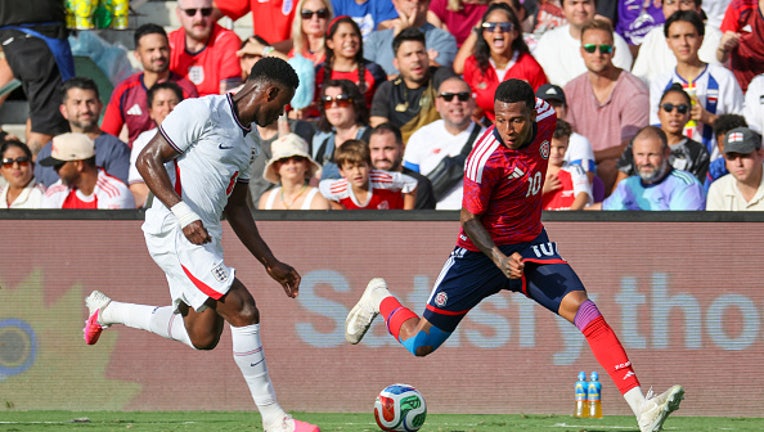
ORLANDO, FLORIDA - JUNE 10: Josimar Alcocer #10 of Costa Rica runs with the ball against Marc Guéhi #6 of England during an International Friendly match at Inter&Co Stadium on June 10, 2026 in Orlando, Florida. (Photo by Alex Menendez/Getty Image
ATLANTA - The World Cup is the single most-watched sporting event on Earth—even outpacing the Olympics. If you have never watched a single second of soccer (traditionally called football outside the U.S.), the global hype can feel overwhelming.
Here's how it all works.
The basics
The World Cup takes place every four years. Countries spend years playing in regional qualifying matches just to earn a spot at the main event.
The tournament is split into two distinct phases:
Phase 1: Group Stage
The tournament begins with a round-robin phase. Teams are drawn into groups of four.
- Every team plays the other three teams in their group once.
- Games in this stage can end in a tie (draw).
- A win earns a team 3 points, a tie earns 1 point, and a loss earns 0 points.
- After three games, the two teams with the most points in each group move on to the next round. The rest are eliminated.
Phase 2: Knockout Stage
Once the group stage ends, the tournament turns into a single-elimination bracket (similar to March Madness). If a team loses, they are out.
Because a team must win to advance, games cannot end in a tie during the knockout stage. If a match is tied after 90 minutes, the following happens:
- Extra Time: They play two grueling, 15-minute halves of overtime.
- Penalty Shootout: If they are still tied after those 30 extra minutes, the game is decided by a shootout. Five players from each team take turns shooting a one-on-one penalty kick against the opposing goalkeeper. Whoever scores the most wins the match.
Matches
A standard match is 90 minutes long, divided into two 45-minute halves. Unlike American football or basketball, the clock never stops running, even during injuries, celebrations, or substitutions. Instead, the referee tracks wasted time and tacks on a few extra minutes (called stoppage time or injury time) to the end of each half.
Yellow Cards vs. Red Cards
- Yellow Card: A formal warning. If a player gets two yellow cards in a single game, they are automatically shown a red card.
- Red Card: Serious foul play or misconduct. The player is immediately ejected from the stadium and cannot be replaced. Their team must play the remainder of the match a player down (10 vs 11).
The Word "Nil"
In soccer culture, the number zero is referred to as "Nil." If a team is winning 2 to 0, soccer announcers and fans will say the score is "Two-Nil." If a game ends 0-0, it is called a "Nil-Nil draw."
The Source: This article includes information from the official Laws of the Game published by the International Football Association Board (IFAB), tournament regulations outlined by the Fédération Internationale de Football Association (FIFA), and foundational player development frameworks from the United States Soccer Federation (U.S. Soccer).